Recent blog entries
This section contains the collection of blog entries specific to the five funding areas or themes that carry a focus by the Shuttleworth Foundation under its general objective to drive innovation, change and policy reform in technology and education.
To see the blogs in context, please consult the relevant sections of the site.
Check back here often to stay up to date with the progress of projects funded by the Foundation and subscribe to our RSS feeds.
-
Shooting Back with a Flip
I had a great conversation with David Carman yesterday who runs a community mesh network in Scarborough (south of Cape Town). We discussed mesh technologies, topologies, and Open Source medical applications but towards the end, the conversation strayed to digital video and security. He told me about a remarkable project in Palestine, called Shooting Back, in which a human rights NGO distributed 100 cameras to palestinian citizens to record human rights abuses. The results are pretty disturbing as this Guardian article testifies but also pretty remarkable. As David put it, often the power of the criminal lies in anonymity. Letting people know that they don’t have the luxury of anonymity can be a powerful incentive for behavioural change.
-
Mozillian brainpower and passion. Yay!
As the old saying goes: 'There's nothing like getting stuck behind a rockslide with 400 of your closest friends.' Okay, maybe it's not an old saying yet ... but it will be as people mythologize and remember the 2008 Firefox Plus Summit -- float planes, candles and all.
-
A few last thoughts on ICeL …
A very belated post on the International Conference on eLearning (ICeL), which I have blogged about. Some thoughts and reflections:
-
Prototyping the open ed revolution
Frank Hecker has a series ofposts up today on 'Mozilla and the Future of Education'. It's a bit of a thought experiment to imagine what Mozilla might do if it dipped it's toe further into the education pond. The line I like most is:
-
del.icio.us tagging - what we are reading today
We have an internal Shuttleworth Foundation IRC channel which mainly consists of comments, banter, understanding where people are, soliciting opinions and, most importantly, links to interesting things we are reading. These readings inform our current thinking and shape our ideas. To share them at large, we have tagged them in deli.icio.us under SFreads (what the Shuttleworth Foundation reads). The RSS feed is to the left of this post, and will be on the front page of our website.
-
Insights into allsorts
This week, the team went on an Insights training course, which whilst a lot of it can be taken with a pinch of salt (how you can fill out 25 questions and define the exact characteristics of each complex individual I will never know) there was a lot of truth found.
-
A few concrete things Mozilla Foundation might do
Looking back over dozens of online and over-beer conversations, it's clear the Mozilla Foundation can play an important role in the world. This role is not to oversee or second guess the people producing Firefox, Thunderbird, SeaMonkey, XUL and other technologies that fulfill Mozilla's mission of keeping the internet open. Meddling with this work doesn't help anyone. However, the foundation can and should build on this excellent work. It can fill gaps (accessibility). It can connect dots (amongst Mozilla communities). And it can reach out to new groups of people with something to contribute (the next million Mozillians). These are basically things that make Mozilla stronger, but are beyond and between what's already going on.
-
Me and Mozilla
Over the past few months, I've been musinga fairbit about Mozilla. The main reason for this is now widely known: I'm hoping to take on the role of Executive Director at the Mozilla Foundation. On Wednesday, Mitchell, Asa and I will be on Air Mozilla to meet the community and get advice on what a successful future for the Foundation would look like.
-
Open Education at OSCON 2008
Danese Cooper has organized what promises to be an excellent conversation about open education at OSCON in Portland. Mark Shuttleworth will be part of the mix. Karien and I prepared some quick background notes for Mark re: what think is exciting in this space and the specific work we're doing. I figured it would be useful to share here:
-
Unbundling education
One of the highlights of this week's PCF5 conference in London was Richard Heller's presentation on the emerging Peoples Uni.project.
-
Budapest + Cape Town: What's Open?
During our PCF5 workshop on the Cape Town Declaration, Paul West and I got into a collegial debate about the definition of an 'open educational resource'. He held up a book he's working on and said: "This contains legal advice that I've had vetted, so I want to release it under a no-derivatives Creative Commons license. I think this is an open educational resource. Do you?"
-
Kusasa project cancelled
We are not afraid to take risks on new ideas or projects and we are not afraid to tell the world when they have gone wrong and failed. The Kusasa project has failed. Essentially we could not reconcile the original vision of the project with the practical realities we faced in South Africa.
-
Dabba in The Economist
In the development world, getting a project profiled in The Economist is a bit like a rock band being profiled in Rolling Stone. This week’s Economist has a profile of Dabba. Pretty cool.
-
Fan Friction?
The appearance of ‘Friction over Fan Fiction‘ an article in the July/August 08 of the Literary Review of Canada signals a new, mainstream concern with a burgeoning phenomenon. TIt also, without intending to, raises to important arguements for limitations to copyright which explicitly set out that fan fiction is permitted.
-
June 2008
We are finally starting to get under the hood of the foundation. We have published the first in our ‘How we work’ series on Open Licensing and have been getting some great feedback. As we know, we are not perfect, but we do have a clear policy on what we want to do and very real ideas and opportunities to get there. Every agreement we enter into, be it with a service provider or in the form of a donation ensures all material and resources are open and will remain so, they are also free from technical protection measures.
-
Telecommunication
Very excitingly, we hosted the first Village Telco workshop. It exceeded all expectations both in the calibre of the people attending and the very concrete outcomes that emerged. Details of the workshop and its results are on the newly hosted website. One key result of the workshop is a plan to create a new device that merges the functionality of a low-cost mesh access point and an analogue telephony adaptor (ATA).
-
Communication and Analytical Skills Development
The Teachable Agents (TA) project is under way. In June two training sessions were held with natural science teachers as well as computer lab teachers from all of the participating schools. The teachers learned how to create concept maps using the Betty’s Brain TA software. The software has also been implemented at all of the schools.
-
Intellectual property rights
During June the Foundation made detailed submissions on two draft Bills. As 2009 is an election year, South African government departments are attempting to put all their pending Bills through Parliament in the next term. As a result the next few months will be a very busy period of responding to legislation which affects access to knowledge.
-
Open and Collaborative Resources
June was Cape Town Book Fair month. Mark Horner participated in a poster session where he presented some of our ideas on print aggregation. The presentation was very well received, with some saying the poster ’stood out for its sheer gumption’. We’ll keep you posted on how this plan unfolds.
-
More on Mozilla: communities, circles and maps
Mitchell and others recently posted about the Mozilla community as a series of concentric circles. These posts make it clear that being a part of a community like Mozilla (or not) isn't a binary switch. Rather, people have varying degrees of involvement and connection. There are different kinds of community members. And, one person might be multiple places in the community at once.
-
Mapping open education policy opportunities
Just before leaving for Italy, I spent a day in London talking with friends about the open education policy agenda. The friends in question were Darius Cuplinskas and Melissa Hagemann from the Open Society Institute, James Dalziel from Macquarie University in Australia and Polish activist Jaroslaw Lipszyc. The conversation focused on how to understand and act on opportunities for government policy that supports the principles outlined in the Cape Town Open Education Declaration.
-
Sub-saharan Africa Undersea Cables in 2010 - maybe
So what might the undersea cable environment for sub-Saharan Africa look like by the end of 2010? Perhaps it will look a bit like this:
-
The Traditions of Knowledge II
In a previous post, the Traditions of Knowledge, I referred to the appropriation of traditional knowledge by means of industrial revolution intellectual property.
-
Dabba wins Social Entrepreneur of the Year Award
Last week in Berlin at a Forum on Social Entrepreneurship hosted by German venture capital company Hasso Plattner Ventures, Rael Lissoos and Dabba won the Social Entrepreneur of the Year 2008 award. The event, sponsored by Deutsches Bank and MAN brought together 250 social entrepreneurs together with investors.
-
The Traditions of Knowledge
Conventional intellectual property laws claim to confer rights only on knowledge is that is individually authored, reduced to material form and ‘original’. The antithesis of that modern knowledge paradigm is traditional knowledge which is by its nature traditional, communal and frequently oral. Some developing countries have adopted sui generis legislation that attempts to craft a regime appropriate for traditional knowledge. But if appropriation is carried out mostly by corporations head-quartered in developed countries, and appropriated knowledge is exploited in developed countries through the mechanisms of conventional intellectual property the sui generis legislation in the country of origin won’t work. This is exactly what seems to be going on.Developing nations including South Africa have advocated strongly for recognition of sui generis traditional knowledge rights in the global trade system through the World Trade Organisation (WTO) and World Intellectual Property Organisation. Developed country trade reps put the kibosh on this idea during the Doha round.
-
Process and content: education needs both
We live in a world where information is being generated at such a rate, and existing knowledge being challenged so readily, that the best education we can give children is to teach them how to learn.
-
The Silence of the Lambdas
I have been gradually getting my head around bandwidth purchasing models for undersea cables. In my second contribution to the Mail & Guardian’s innovative Techleader site, I use a real estate metaphor to contrast the various scenarios.
-
Social Constructivism in Games Based Learning in The South African Context (ED-MEDIA 2008)
ED-MEDIA 2008 paper: Social Constructivism in Games Based Learning in The South African Context. Ab
-
Book Review: Globalization and Its Discontents
Globalisation and Its Discontents has a far better description of globalisation than the World is Flat, which I have previously reviewed. This even though the book is primarily concerned with global financial governance, the IMF and the World Bank, and how they behave, especially in the developing world. Stiglitz contends that IMF’ policies have attempted to serve Wall Street have failed not only developing countries but the global economy and so the United States. The explanations of the economics is clear, and easy to follow. This is all the more remarkable since Stiglitz is a Nobel Prize winning economist, rather than a journalist or trade author. -
Village Telco Workshop
At the Shuttleworth Foundation, the geek factor runs pretty high for a charitable foundation. However, my colleague Jason and I felt like lightweights at the the Village Telco workshop that we hosted here at the Foundation two weeks ago.
-
ProBoPortable: Development of Cellular Phone Software to Prompt Learners to Monitor and Reorganize Division of Labor in Project-
ED-MEDIA 2008 paper: ProBoPortable: Development of Cellular Phone Software to Prompt Learners to Monitor and Reorganize Division of Labor in Project-Based Learning.
-
It’s not about the technology
At ICel 2008 Sue Greener of the Brighton Business School, University of Brighton (UK), presented her research titled Plasticity: The Online Learning Environment’s Potential to Support Varied Learning Styles and Approaches.
-
Scaffolding + support + investment = MoFo?
The Next Million Mozillians post has sparked some interesting ideas: browser plug-ins that make the whole of the web equally about consumption and contribution; simpler community-powered translation for open content and collaboration; helping people like educators who can weave open knowledge into the core of their work. It has also generated some good questions. What do we mean by the open web? And which bits of it is Mozilla Foundation best situated to drive? I'll loop back with an in-depth synthesis of all the comments and posts (keep 'em coming) in a couple of weeks when I am back from Italy.
-
Learning from open access
Yesterday, Melissa Hagemann, Eve Gray and I led a workshop called Opening Scholarship at Elpub 2008. Our aim was to dig into a very specific question: what lessons can those of us working on open education learn from the open access to research movement. As the room was filled with experienced open access folks (that's the theme of the conference), it seemed like a good place to ask this.
-
Shuttleworth open licensing policy now online
A few months back, I posted a draftHow We Work article on the Shuttleworth Foundation's open licensing strategy. The basic idea is that we want everything we do and fund to be under an open license. As my article says, this hasn't always worked as we haven't had a clear policy on the matter. Good news: now we do.
-
Agile philanthropy: how our fellowships work
Last month, we sat down to have another How We Work conversation at Shuttleworth Foundation. Under the microscope this time: our Fellowships Program. We're all pretty happy with this program. So, the aim was to reflect on why it seems to be working ... and to find ways to tweak and improve it.
-
The Next Million Mozillians
Last week, David Eavesblogged about the potential for Mozilla to energize -- and maybe even lead -- a mass movement for the open web. My response: hear! hear! More thinking, experimenting, conversing, inventing, definitionizing, evangelizing, politicking, standard-making and party-throwing in the name of the open web is very much needed. And Mozilla is certainly well situated to stir this pot.
-
Thoughts on Information for Change II
Today I attended the Information for Change II workshop held at the Cape Town Book Fair. It is still a little unclear exactly how I came to be there, apart from driving I mean. Bill Carman and Steve Song arranged it so that I got to present a poster on our latest pet idea, the print aggregator.
-
Yin-ing and yang-ing open everything
Writing up Open Everything Torontodebrief notes, I realized that striking the right yin-yang between impressive and surprising examples of 'open' will be one of the most critical factors for future events.
-
Intellectual Property Rights from Publicly Financed Research Bill
A putative bill which creates a system require patenting of tax payer funded research will be published today.
-
May 2008
May 2008 was a really great month at the Foundation. We went through what seemed like a spring clean of our thoughts, processes and communications.
-
Telecommunication
We continued working towards democratisation of the telecommunication infrastructure by defining and organising the key players and stakeholders in the Village Telco initiative together. We will have a workshop next month and have commitment from all to participate fully. This will be the first time they have all been together and we are very much looking forward to shaping the project further.
-
Open Standards - It’s Not Just Good for the Internet
A talk worth watching is Paul Collier’s heartfelt presentation at the TED event earlier this year. He talks a bit about his book The Bottom Billion which, as a non-economist, I am finding both insightful and accessible.
-
Book Review: Coercion, why we listen to what “the” say, by Douglas Rushkoff
Anyone living in a consumer society is likely to benefit from reading this book, finding it an insightful if disturbing expose of manipulation techniques employed by marketers, media and politicians. You will never trust a salesman again. -
Open edu-thing
With Open Everything Toronto a week behind us, blog reflections, notes and photos are starting to trickle online. One of the highlights so far:Amanda Yilmaz's write up of the Seneca Open Source Course session.
-
ISO suspends OOXML while considering Appeals
According to a press release the International Standards Organisation has suspended publication of OOXML as an ISO standard during the appeal process.
-
The need for localisation of serious games
Last week was the 5th annual Games for Change conference in New York. An interesting blog post to come out of that discusses the need to localise social issue games.
-
I love “This American Life”

-
Round-up of eLearning Africa 2008
I’ve posted a round-up of the eLearning Africa conference on Tech Leader. Helpful input to the pie
-
Open everything. Right here. Right now.
Today, Toronto kicks off Open Everything: a global series of six (or more?) events about the art, science and spirit of open. We've got 60 amazing people registered who come from computer programming, community development and everywhere in between. It's gonna rock.
-
ACTA, descisive step towards the abolition of IP?
I have been hearing a lot lately about ACTA, a treaty which is being drafted at the behest of a handful of old economy monopolies. IPJustice has a useful anaylsis. ACTA is an accroym for Anti-Counterfeiting Trade Agreement. Who could be against measures to prevent counterfieting? No doubt the name was chosen for exactly that reason, to imply that anyone who wishes to debate the provisions or even the necessity for the agreement. Its also sold as a trade agreement, which in some of the countries taking part in negociations means that executive sign-off is suffecient to bind that country, and the treaty need not pass scrutiny by the legislature.
-
Fruit from PALM Africa
I have recently returned from Uganda. From 27 to 29 May 2008 I participated in the PALM Africa Workshop on alternative publishing models in Africa, which was hosted by the National Book Trust of Uganda (NABOTU). The participants in the workshop represented a wide range of types of organisations, including public and private sector publishers, and an equally wide range of competences, and attitudes toward alternative publishing models. The organisers of the workshop are to be congratulated on patiently and persistently explaining the potential benefits of alternative licensing. Experimenting with alternative publishing models offers a low cost, low risk way of testing the opportunities available to developing country publishers.
-
Digital storytelling for Africa
My presentation at eLearning Africa was Digital storytelling for Africa: Case study of an international digital media project.
-
Cape Town - City of Fibre
On Wednesday this week, the City of Cape Town made the final approval to launch its ground-breaking municipal Broadband Infrastructure Project.
-
Mobile phones and education
Below are notes from the eLearning Africa session titled mobile phones offering a lifeline to learners.
-
Serious sillyness
There are hordes of really impressive yet undervalued resources for teachers, parents and kids to use. I keep mentioning that I want Kusasa to embrace other resources and facilitate their use.
-
the cost of not getting good ideas quickly
I am in Kampala at a workshop hosted by the National Book Trust of Uganda on alternative publishing models, PALM Africa. The air is full of new ideas, emerging business models…change.
There is considerable promise that local publishers will be able to find new sources of sustainability and increase access to knowledge. These are important benefits of open access publishing models. There is another, often overlooked benefit of open access publishing models.
-
128 physical manifestations of disease ...
Ok, the title is probably not worded very precisely but it's in the right ballpark. During the meeting today, one of the people from the University of Michigan mentioned that there are only 128 symptoms (is this the right word) a patient can present, it was a talk about health faculties sharing OERs. This had never occurred to me, but, in my defence, I had never ever even thought about it.
-
Who should make OERs?
I just wanted to capture a concern and some thoughts around it. Today I heard it said in a meeting that available OERs are of low quality, irrespective of their cost. This was used to justify the statement that we should not expect OERs to be cheap, we should focus on their quality even if that means that they are expensive. This certainly doesn't sound like something I should be concerned about but it is. It can be used to justify spending vast sums of money to have a few experts write material which is released under an open licence.
-
Practising my open philanthropy rap
During my recent trip to Cape Town, the Foundation held a 'messaging meeting'. This is basically a communications group therapy session. Everyone has two or three minutes to deliver a pitch on their work and projects. After watching a video playback of each pitch, the group offers constructive criticism.
-
Building a hothouse
Last week, I had a rare 45 mins withMark Shuttleworth. He asked: what do you think the Foundation has achieved in the last year? I answered that it had 'stabilized and grown strong'. Which is true. After a few rocky years, the Foundation is now in a position to actually pursue big ideas like free textbooks and learning analytical skills p2p-style in a serious way. Yet, I knew my answer wasn't quite right. The Foundation hasn't just stabilized, its, well, this sounds silly, but ...
-
Full Text of the South African Appeal on DIS 29500
Here is the full text of the South African Appeal iro the ISO OOXML process.
“Appeal from the South African national body regarding the outcome of the fast-track processing of DIS 29500 Office open XML
-
Proudly South African: South Africa takes the lead in appeal against OOXML process
In the midst of grim and troubling news about outbreaks of violence against Zimbabweans and Mozambicans, there is a good reason to be proud of being South African today.
-
why free local calls is a promising policy move
In many countries a basic monthly telephone subscription entitles the subscriber to free local calls. In other words, a subscriber pays a flat fee, and can make any number of phone calls within that area without paying any additional amount.
-
first step on a long road: Microsoft Office to support document conversion to ODF
Microsoft has announced that it intends future versions of Office to support Open Document Format, the international open XML document format used by other developers.
-
Literacy for all ...
Today I got to have breakfast at the Mount Nelson. It was quite disappointing from a food perspective but we, Steve Vosloo and myself, were there for the Breakfast Club as Naledi Pandor, Minister of Education, was the guest speaker.
-
May the copyright be with you
Siyavula is a project focused on the development of educational materials. These materials will ultimately be hosted on a website with the primary authors being teachers. The question needs to be asked (and answered) as to who will (or should) own the copyright to the material on the website? Some initial thoughts relating to this question are below although every time I discuss it I want to explain it completely different so expect many follow-up postings!
-
End of this blog
I'm switching to Wordpress. Ukubuza is now officially laid to rest. All of the postings from here have been transferred to my new blog: innovating education.
-
Grand Theft Morals, or ultimate role model?
Grand Theft Morals, or ultimate role model? is a piece written for Tech Leader, the M&G’s new offering in the Thought Leader stable.
-
Thoughts on the new science curriculum
Today, Diane Grayson gave a talk at UCT on the new Physical Science curriculum being delivered in South African schools. Diane discussed the curriculum, its structure, features, teacher's complaints and gave some of her views on the various topics and issues.
-
Subscription based open content aggregation
Mark Surman has written about an interesting new business model: Noank. You have to read his post to understand this one.
-
Tinkerless or tinkermore?
The Guardian this week published a review of Jonathan Zittrain’s book “The Future of the Internet and How to Stop It.” The journalist quotes Zittrain as saying
-
How To Be Transparent in Fibre Optic Cable Deployment
Bill St. Arnaud points out that Pipe International, who are building an undersea cable from Sydney to Guam, have taken a completely transparent approach to communicating about project development and progress. Even to the point of having dynamic online maps of cable development.
-
April 2008
At the Foundation, we aim to drive innovation, we pilot projects, we comment and cajole in policy discussions and we slowly move forward to a better, more connected, more educated and prosperous South Africa (and Africa and the world).
-
Constitutional Review: Increasing ICASA’s Independence II
-
Parliamentary Portfolio Committee on IPR from Publicly Financed Research Bill
The Parliamentary Portfolio Committee on Science and Technology, (National Assembly), will receive a briefing by the Department of Science and Technology on the Intellectual Property Rights from Publicly Financed Research Bill (IPR Bill)], Venue to be confirmed, 10:00, Tuesday 3 June, 2008.
-
The world is flat (rate)
Today was CopyCamp2 in Toronto: a conversation about art, copyright and the Internet. Lots of fun examples of remix art. More Linux stickers and Internet savvy artists than last year. And a few boring culture bureaucrats playing broken records. Not a bad cocktail, all told.
-
Dabba and Village Telco: Getting to Alpha
Here is a short note on where things stand with Dabba and the Village Telco. The Shuttleworth Foundation is planning to fund the hacking/adaptation/development, to at least alpha version, of an Open Source “Village Telco” integrated suite of applications.
-
Of snowballs and speedgeeks
I love watching snowballs roll downhill. The whole unconference meme is certainly one such snowball. In many ways, geeks have taken open space meetings further and wider in the last three years than mainstream facilitators have in the last 20. Which, as someone who has tented in both camps, has been amazing to watch.
-
Constitutional Review: Make ICASA truly independent
Every year the Constitution of South Africa requires that the provisions of the constitution should be reviewed. A parliamentary committee reviews the provisions of the constitution. This year an invitation for public submissions (details below) has been sent out, submissions due by the end of May.
-
Building the Demand in Print-On-Demand
In an earlier post, I wrote about a very cool publishing model used by a bible publishing company in the U.S.
-
Operators Response to SA Government’s Proposed Rapid Deployment Guidelines
On the 27th of February 2008, the Department of Communications published a notice inviting comments on Proposed Guidelines For Rapid Deployment of Electronic Communications Facilities in Terms of the Electronic Communications ACT, 2005 (ACT NO.
-
What's at stake: net neutrality 101
Being Canadian, I've spent a great deal of time recently explaining what's at stake with net neutrality. Everyone gets the huge importance of keeping the Internet open, but many find it hard to believe that there really is a threat.
-
Sharing without borders
At the Foundation, we want to drive innovation in education and technology. How we get there is not such a simple statement.
-
Open salad
Salad makes a perfect open source project. While most people think it's a drag to produce a whole salad, it's not so hard to get them to cough up one or two ingredients. The ingredients people contribute automagically turn out to be complimentary, most of the time. And, as more people contribute ingredients, the salad gets better and better. Yum.
-
Open Patents, Open Concepts
File this one under thinking out loud but why isn’t there a commons for ideas? For example, if I came up with a useful workshop facilitation methodology, I would share it. However, if I knew that I was likely to be given credit anytime anyone used it, I would probably share more enthusiastically and maybe even put more effort into polishing the methodology for use by others.
-
The Wisdom of Knowledge Management
I lurk on one of the more interesting mailinglists in the world. act-KM, originally an Australian but now global community of practice on Knowledge Management or since I abhor the term Knowledge Management, let’s say on the nature of knowledge in general and how to make it grow and flow in and across organisations. It is a high traffic list and not a very peaceful one. The debate rages (I choose the adjective carefully) between academics, practitioners, corporate hacks, and grass-roots types. It is not always kind and at times I find some of the sniping simply unpleasant. However, that is substantially outweighed by the calibre of discussion. It is a privilege to hear the likes of Dave Snowden, Steve Denning, Patrick Lambe (to name just a few) hashing issues out in a community space.
-
Looking for Possible Village Telco Entrepreneurs in Khayalitsha
 Having decided to help Dabba explore the replication of their Orange Farm success down here in the Western Cape, it was not immediately clear to me how to go about finding the right place for such a project. Alan Levine of Vanilla (Dabba’s partner in the Cape) initially provided a connection to a local NGO working with schools to provide support services to children affected by HIV to enter formal schooling with the necessary skills. However, after visiting the NGO sites, it was evident that while there was interest in the Village Telco concept, technology and entrepreneurship were not their sweet spot. They could see the value and would make great clients but were not the sort of organisation to drive an idea like this.
-
Philanthropy on the commons
I spent the weekend mulling over Mike Edwards' essay Philanthrocapitalism: After the gold rush. The basic argument is this: there is a movement afoot to harness the power of business for social change. This includes newly-minted foundations like Gates, corporate social responsibility programs and social entrepreneurs. These philanthrocapitalists are undermining the independence and social mission of civil society. As a result, we are missing out on real social transformation, and maybe even risking our democracy.
-
Siyavula vs. Publishers - NOT!
Normally when I tell someone about my personal project, Free High School Science Texts (FHSST), or my day job, Siyavula, the average response includes the following elements:
-
We are opening: free textbooks for South Africa
Mark Horner launched his Siyavula blog this week! Yay! It'll be a great way for people to track this ambitious and important open education project. For those of you who don't know:
-
A new initiative: Siyavula
I recently (Oct 2007) changed jobs and am now working for the Shuttleworth Foundation managing an initiative called Siyavula. Siyavula is the Nguni word meaning we are opening.
-
Intellectual Property Rights
What we do in this area:
“Intellectual Property Rights (IPR) were originally instituted to encourage the creation and invention of public goods for the benefit of society by allowing creators and inventors to protect their intellectual property. However, IPR has become overly restrictive in recent times as corporate interests have led to an ever increasing demand for lock-down on rights.
The Shuttleworth Foundation supports initiatives that call for the establishment of national and global IPR regimes that seek an appropriate balance between encouraging innovation and benefiting society, the original purpose of creating the rights. “
-
Open and Collaborative Resources
What we do in this area:
“Teachers, learners and authors around the world are increasingly seeing the potential of open educational resources. As part of a broader movement to open up education, these resources can increase access to learning opportunities and encourage more collaborative, student-centric learning. The Shuttleworth Foundation works closely with the innovators and activists who are bringing this movement to life.”
-
Open everything unfolds
The Open Everything idea I've been talking about for a while has started to pick up steam. There is now a tiny web site up. And, there are events planned for London, Cape Town, Toronto, Singapore and a small, wonderful island off the coast of British Columbia.
-
The World Rejects OOXML
The most populous countries in the world have rejected the OOXML as an international standard but its been pushed through anyway. China, India, Brazil and South Africa have all firmly rejected OOXML as an international standard, in a re-visit of the voting process which took place during September 2007.
Although ISO has yet to officially release the result, early reports suggest that extensive lobbying has engineered a vote change in a sufficiently large number of countries so that the specification will be pushed through.
-
How to stem the Matthew Effect in education
How to stem the Matthew Effect in education is a piece I wrote about a presentation given by Dr Luis Crouch at the Integrated Education Programme (IEP) conference (in February).
-
Open licensing, and how we work
As I blogged previously, I'm doing a series of short pieces that look under the hood at the day to day work of the Shuttleworth Foundation. As the opening blurb to my first article says:
-
Pivot - Stick figure animation for storytelling
One of the very cool things about Kusasa is that I get to visit schools and just hang around and observe. Often I am interested in trying to pin down scenarios where kids share ideas or assist each other to see if we can build similar scenarios into our own material.
-
In Praise of Taking Things Apart
The Economic Value of Taking Things Apart
In the Concise Encyclopedia of Economics, Paul Romer writes:
-
Challenge. Change. Conversation. Revolution.
Whatever it is that I do for a living today, it all started with community video. Five years as a portapak toting video activist in the early 90s gave me deep roots. It sparked DIY entrepreneurship and hacking. It taught me that media is conversation. It fascinated me with the power of fluid, open, participatory ways of working. In so many ways, community video made me me.
-
Dabba: Open Source Components - Access Node
Dabba relies on a variety of Open Source software application to enable their network. Here is a profile of some of those applications.
-
Kenya: Door opens for new non-profit telecom firms
Business Day Africa profiles the Communications Commission of Kenya’s decision to offer ISM-band spectrum to non-profits:
-
Pirates, Professors and a Political Compass
Over the past week, I've been reflecting on the ideas of two people: Jonathan Zittrain (a professor) and Matt Mason (a pirate, or at least a fan of pirates). This has got me thinking about the 'political compass question' again, which goes something like this ...
-
Why does everyone want to kill WiFi?
Reading the tech news in South Africa, you get the impression that WiMax is going to very shortly solve all of the country’s broadband issues. Articles like this one give the impression that WiMax will shortly be available in every major city in South Africa. Municipal WiMax enthusiasts argue that this is “no business case for WiFi”
-
South Africa: Income Spent on Communication

 The conventional wisdom in the ICT4D community is that people in developing countries spend a higher percentage of their income on communications than the global average. For South Africa, this notion became is widely accepted (I think) thanks to the Vodafone study on mobile usage, in which Diane Coyle of Enlighenment Economics says:
-
Shoelacing social innovation
Social innovation (or any kind of innovation for that matter) can be a lonely gig. There you are, focused intensely on an issue or problem that you are passionate about, trying to invent / evolve / evangelize an approach that will really make a difference. Poverty. Hunger. Education. Democracy. Knowledge. Whatever the issue, that's all that matters. One day, you'll have time to connect to other innovators to share what you know ... and learn about what they're working on. But not now. One day.
-
Communication and Analytical Skills Development
What we do in this area:
“The Shuttleworth Foundation is involved in research into the idea that the two core skills acquired by learners at school are communications and analysis. As such, the transfer of these skills should be prioritised – especially in the African context where resources are often scarce and fundamental skills require specific focus.”
-
February 2008
Structure:
Each monthly report will be broken up into 5 different posts. One general post about how we are and what we have been up to and 4 based on investment area (telecommunication, IPR, communication and analytical skills and open and collaborative resources). Each post will be tagged appropriately and all posts from the same month will be categorised as such (this month’s is February 2008).
-
Telecommunication
What we do in this area:
“The cost of bandwidth in Africa poses a barrier to the continent’s effective participation in international trade and the knowledge economy, while limiting local markets and education. Without adequate bandwidth Africa runs the risk of being left behind in the global race. The Shuttleworth Foundation is, therefore, actively investing in a project portfolio that will contribute towards solving bandwidth limitations in the African context.”
This month’s highlights:
-
Intellectual Property Rights
What we do in this area:
“Intellectual Property Rights (IPR) were originally instituted to encourage the creation and invention of public goods for the benefit of society by allowing creators and inventors to protect their intellectual property. However, IPR has become overly restrictive in recent times as corporate interests have led to an ever increasing demand for lock-down on rights.
-
Open and Collaborative Resources
What we do in this area:
“Teachers, learners and authors around the world are increasingly seeing the potential of open educational resources. As part of a broader movement to open up education, these resources can increase access to learning opportunities and encourage more collaborative, student-centric learning. The Shuttleworth Foundation works closely with the innovators and activists who are bringing this movement to life.”
-
Yabba Dabba Do
 Meet Rael Lissoos, a economist turned geek entrepreneur. While I have been talking about Village Telcos, Rael has been out building one in Orange Farm, a township about an hour south of Johannesburg.
-
Notes from the Integrated Education Program (IEP) Conference
A little late, but below are my notes from the Integrated Education Program (IEP) Conference in Pretoria (6-7 February 2008).
-
Reporting meaningfully
The Shuttleworth Foundation’s mission is to drive innovation in education and technology. Philosophically, we do that by: accelerating great ideas and removing barriers. Practically that means we pilot projects and pedagogies, and back excellent people to drive help drive our agenda.
-
Planting seeds with open content
John Moravec of Education Futures posted today on the Cape Town Declaration, worrying that open course materials will do little to change education. He asks:
-
Open, philanthropy and a theory of change
A number of people have been asking me lately: what happened with the open philanthropy work that you posted about last September?
-
Great diagrams: How to Make Lasagna Instead of Spaghetti
 Earlier this week I came across this wonderful master’s thesis entitled Generation of Complex Diagrams: How to Make Lasagna Instead of Spaghetti by Noah Iliinsky. We have all at various times had our minds numbed by needlessly complex diagrams that did more to obscure the issue than explain it. This is the first insightful analysis I have seen about what makes a good or bad diagram. Well written and with many excellent examples of great and awful diagrams.
-
Seacom Sets Date, Reveals Pricing
Seacom has emerged as a clear front runner in the African undersea cable stakes. They are the first initiative to declare a completion date, 17 June 2009 (after which cable company Tyco will incur performance penalties). More impressively they have revealed their wholesale pricing scheme which looks like this:
-
Community Pricing for on-demand publishing
Tim O’Reilly points out some very cool publishing models being used by Logos Bible Software. The have a pre-publishing service in which clients commit to order at a discount in exchange for placing a pre-order for a specific product and Logos can guarantee that there costs are covered. Each potential pre-publish book has a meter which displays the current level of pre-orders.
-
African Undersea Cables - Map
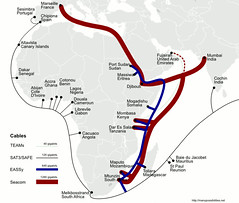 In the spirit of the previous post consolidating information on African undersea cables, I compiled the image at the right to create a consolidated picture of existing and future cable initiatives around the continent. The relative cable sizes are roughly to scale according to the advertised capacity of the cables. There is certainly a contrast between the various initiatives.
-
Connected Cities: The Rebirth of Geography
As Mark Twain once said, “reports of my death were great exaggerated”. This could be very aptly applied to the optimistic perception that the Internet and cheap telecommunications meant that it didn’t matter where you were, the so-called “death of geography”. The future was in telework and invisible global supply chains. While there is truth to the flat world notion popularised by Thomas Friedman, it is equally true that “local” has become more important than ever. Strangely the more connected we become, the more local seems to matter.
-
ICASA: Death by Bureaucracy
“…broadband thrives on a mix of competition and active regulation, to ensure an open context.” This succinct summation comes from an Economist article from a couple of weeks ago entitled “Open up those highways“.
-
bag of tricks…
Part of the idea for the Kusasa blog was to create a space for recording ideas and insights that are linked to the Kusasa approach. Kusasa is more that just the content we are creating, it represents a kind of head space. Last night while watching Cameroon trounce Ghana in the African Cup of Nations semi-final I started teasing out the following thoughts:
-
Theory of Change: The Village Telco
Having funded and watched and occasionally participated in the wireless hacker space in Africa for the last few years, I have the sense of “waiting for the next leap forward”. Wireless hackers have been successfully building cantennas, woktennas, and waterbottletennas, to name a few. They’ve been flashing Linksys Routers with a variety of free firmware replacements and in general tinkering with WiFi in a very cool way. I say cool because I think tinkering is one of the best ways of learning about something and also because taking something apart is a way of demystifying technology and ultimately making it something that serves you as opposed to the other way around.
-
African Undersea Cables
Mostly in order to keep them all straight in my head, I have compiled a list of African undersea cable initiatives and their features, investors, etc.
-
Nokia study predicts rise of 'circular entertainment'
A new study from Nokia and The Future Laboratory predicts that by 2012, a quarter of all entertainment will be "circular", that is created, edited, and shared within peer groups rather than being generated by traditional media. The bulk of the study was based on interviews with trend-setting consumers from 17 countries about their digital behaviors and lifestyles.
-
Cape Town Declaration. Read it! Sign it!
Over the past couple of months, I have been working with an amazing group of people committed to the idea of open education. The group ranged from university lecturers from South Africa to a woman managing a free textbook project in Uganda to America open education pioneers to a free culture activist from Poland to the founder of Wikipedia. Coming from a dozen countries, it was one of the most diverse, productive and creative groups I have worked with in a long time.
-
the cape town declaration on open education, beta test
“We are on the cusp of a global revolution in teaching and learning. Educators worldwide are developing a vast pool of educational resources on the Internet, open and free for all to use. These educators are creating a world where each and every person on earth can access and contribute to the sum of all human knowledge. They are also planting the seeds of a new pedagogy where educators and learners create, shape and evolve knowledge together, deepening their skills and understanding as they go.
-
Workshop: Blogging in the classroom
ICT4Champions is a Google group concerned with the use of web 2.0 in South African schools. Today Maggie Verster, founder of the group, lead a workshop on blogging in the classroom. It was attended by 10 educators, all from private schools, who were shown how to create and customise a class blog using Edublogs. I attended to meet Maggie and the others in the group and to pick their brains on the state of Web 2.0 in our schools. The bottom line: basic use of ICTs, let alone for connected, creative, collaborative web 2.0 activities, is limited and problematic in South African schools. According to the attendees of the workshop, reasons for this include: