|
||||
|
What is the difference between a bright idea and an innovation? A bright idea is the start of a process; an innovation is an idea that has been brought to the market and is successfully improving the way we live, learn and do things. Without the process, a bright idea will remain what it is – a thought that is of no practical use to anybody.
At the Foundation our quest is to bring innovation to education and to support the process that grows a bright idea into an innovation. We want to find new ways of working with existing resources and bringing changes to our fields of interest: science, technology, entrepreneurship and maths. If one looks at the current scenario, millions of rand are spent each year on education – often without making a difference equivalent to the amount invested. Obviously, we need to change the way we do things; we need to be innovative in how we approach the challenges in education and in how we use the resources at our disposal. This drive for innovation is apparent in the type of pilot projects we invest in: The Paarl Association of School Governing Bodies (PASGB) is a project that we have been supporting over the last year, and it is a good example of changing the approach in order to implement a project in an innovative way. This association of school governing bodies is involved in organising and facilitating a science expo at various levels in their area, with the goal of sending successful learners to participate in regional and national science expos. What makes this project innovative is that it is the parents and school governing bodies that are proactively trying to improve the learning and teaching in the schools that their children attend. They are improving the system from within, instead of approaching outside organisations to generate change. An innovative approach to using existing resources is the ‘Africa Meets Africa’ project, which seeks to contextualise the learning of mathematics within indigenous knowledge and cultures. It does this by, for example, looking at Zulu designs (beadworks & pots) and the mathematical concepts behind them. In this way it uses elements that the learners know and are familiar with (many of them being involved in making the crafts) and then showing them the mathematics behind them. And so, it again comes down to effectively using our resources, maximising our output levels and really, it’s thinking about the best possible way to achieve our goals. That, we believe is innovation.
CAPACITY BUILDING WORKSHOP The Presentation and Communication Skills Workshop to be held on the 12th of October 2004 from 9am – 4pm. Closing date for applications is the 27th of September 2004. Please contact Vuyi @ (021) 970 1206 or e-mail her on . INNOVATION BAZAAR – BUYERS HANDBOOK AVAILABLE TO FUNDERS The Innovation Bazaar 2004, funded by the Shuttleworth Foundation and PetroSA, is set to take place in Newtown, Johannesburg on the 25th of October. In the past, only a limited number of projects were selected to participate – these projects, described as vetted projects, are all comprehensively investigated, assessed and trained so that funders attending the Bazaar can be certain of a minimum standard of projects showcased. We have already selected, assessed and trained 23 projects as part of the vetted projects category for Innovation Bazaar 2004 This year, to afford the networking and exposure opportunities of the Innovation Bazaar to more projects, we have introduced a second, open category of non-vetted projects. These projects, which have not gone through the Innovation Bazaar evaluation and capacity processes, will exhibit together with the vetted projects. Up to 30 projects will be able to participate in the open, non-vetted category. Exhibition stalls will be provided for all of the selected projects, with vetted and non-vetted projects clearly differentiated. In order to select the 23 vetted projects, first round applications went through a strict assessment process. These vetted projects participated in a week-long workshop, with the specific aim of not only assessing the organisations’ capacity, but also of building their capacity to empower them to ‘sell’ their projects effectively. The 23 vetted proposals range from projects encouraging pupils to think of science, technology, entrepreneurship & maths, as subjects that can develop into future careers; to training teachers to be able to teach these subjects more effectively; to providing resource tools such as software to assist with teaching maths, science & technology. All of the proposed projects have strong community influence and participation. Annamarie van der Merwe, Chairman of the Iscor Trust, and participating ‘buyer’ in the first Innovation Bazaar in 2003 says that the selection of vetted projects is extremely advantageous to ‘buyers’: “Many corporate trusts and foundations struggle to identify viable and sustainable CSI projects, due to a lack of internal resources. The Bazaar is a proactive way of ‘meeting’ potential projects, instead of waiting for the right project to find its way into your office. The vetted projects are guaranteed to be of good standard and have credibility, because they have gone through a solid selection process.” “The non-vetted projects differ in that they will be ‘raw’, in other words, they will not have gone through any of the vetting, assessment and capacity building processes that the 23 selected ‘sellers’ have undergone”, says Kim Vosse, Projects Manager at the Shuttleworth Foundation. “We have decided to include other projects so that as many ‘sellers’ as possible are able to gain from the exposure and networking opportunities at the Innovation Bazaar.” The event is open to all funding organisations, whose funding mandate includes the support of the four subject areas as part of school education, interested in attending. All queries can be addressed to Kim at or (021) 970 1210.
GO OPEN SOURCE CAMPAIGN The Go Open Source campaign was recently launched by The Shuttleworth Foundation, HP, the CSIR, and Mark Shuttleworth personally. Go Open Source is a nationwide awareness campaign promoting the adoption of Open Source Software (OSS) in South Africa, and will run for the next 2 years. The campaign, a world first, aims to make ordinary computer users and those who aspire to be computer literate aware of the benefits of OSS. Thomas Black, Open Source Program Manager at the Shuttleworth Foundation explains: “We'd like to ensure that home computer users, small and medium sized businesses, students, school pupils and people who want to become computer literate have heard about and tried OSS for themselves. This campaign will put OSS within easy reach of every South African, and help South Africans to understand why early adoption of open source gives them an advantage in the global economy.” South Africa is not the only country that is beginning to invest heavily in OSS. Developing nations such as Brazil, India, and China are also realising the extensive benefits available through OSS adoption – from high-level corporate and government adoption right through to school, small business, and home adoption. The Go Open Source campaign aims to accelerate the awareness of OSS within South Africa and ensure that in 2 years time South Africa is at the forefront of OSS adoption. The partners have identified Open Source awareness as one of the primary keys to achieving their goals over the next 2 years and a comprehensive media campaign has been launched. This campaign is running across print, radio, and television with the highlight being a dedicated Open Source television series launching towards the end of 2004. As for availability and accessibility to the actual software, the campaign is distributing CD's freely via the Go Open Source website and through the South African network of public libraries – with a retail distribution component being added at the start of 2005. Mark Shuttleworth, supporting the campaign in his personal capacity says, “I believe that Open Source is the future of the software industry. In just a few years OSS will become the standard for computers around the world. Go Open Source is a way for me to bring those benefits to other South African entrepreneurs.” “Our goal is to ensure that in two years time every South African who uses a computer, or who wants to use a computer, knows that they can get all the software tools they need for computer literacy and computer mastery free of charge, together with the right to share those tools and to improve them as they see fit,” Shuttleworth concludes. THE NUMBER SKILLS PROJECT Research has established that children develop number skills best through play. When they are not encouraged and given space to play there is a low probability of successfully teaching them advanced mathematics as they grow older. Without play, the core stages of numeric development become stunted, with very little chance of improvement without special attention. The acknowledgement of the link between play and developing number skills led to the development of the Number Skills project. The Foundation is running this project in the Limpopo Province in partnership with the Tzaneen Rotary Club. The aim of the Number Skills project is to explore the impact of SMILE educational products in improving number skills. The project involves the training of Grade 1 to 4 educators from 16 schools in the Limpopo Province in the use of SMILE educational products to develop and enhance the number skills of learners. Educators will learn how to integrate the use of numeric play, through the SMILE products, with the set curriculum as a guideline. This will enable learners to develop and enhance the core skills critical for the future understanding of broader mathematical concepts, increasing the possibility of making mathematics easier to understand. The interactive methodology suggested in this programme will make the teaching and learning of mathematics fun and more desirable. TEACHER MENTORSHIP PROGRAMME According to the TIMSS (Third International Mathematics and Science Study) South African learners are consistently weak in mathematics and science at the Grade 8 level, compared to other international participants. The study identified as many as 20 different factors contributing to the low performance of South African learners, but a significant factor identified is the competence and attitude of teachers. The Department of Civil and Biosystems Engineering at the University of Pretoria in partnership with the Engineering division of the Tshwane Muncipality will mentor a total of 24 maths and science educators from 4 participating schools from Eersterus and Mamelodi townships in Pretoria, as part of the Teacher Mentorship Programme. The mentorship will focus on various aspects of teaching including time management, content or conceptual understanding of maths and science, evaluation and assessment, issues around outcomes-based education and the further education and training band, new methods introduced by the Department of Education, and computer literacy. An important element of the programme will be the focus on increasing educators’ awareness and understanding of careers in the related fields so that this information can be filtered down to learners. This comprehensive mentoring programme also involves the on-going skills training of educators in the classroom without disrupting the normal teaching process. The ultimate aim of the programme is to improve the science and mathematics departments at participating schools, ensuring that future groups of learners at these schools are all equally stimulated and empowered. Organisers are hoping that mentored educators will become “seeds” that will develop similar support groups/mentoring programmes at other schools.
CODE BREAKER Together with Media 24 (YOU, Huisgenoot and Drum Magazines) and the Telkom Foundation, the Shuttleworth Foundation will be launching Code Breaker later this year - an exciting, futuristic media-based science fiction competition. Targeted roughly at Grades 8 & 9, the Code Breaker competition will run over 8 weeks. Each week, through photo-realistic images and high tech digital creativity, a story unfolds and challenges the reader to decode an encrypted message. Decryption is done by solving a series of puzzles or riddles which help to decode the cryptic message and provide an answer to the weekly competition question. Through the story line, virtual characters and weekly challenges, the competition incorporates energy and excitement around science, technology, entrepreneurship and maths as part of everyday life. We look forward to bringing this exciting competition to you – look for the launch this month. Prizes for the competition are sponsored by Swatch, Sahara and HIP2B².
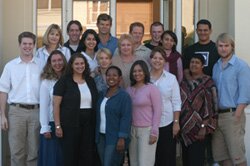
The Foundation has established a new advisory committee, consisting of a diverse group of individuals who have expert knowledge in the learning areas of science, technology, entrepreneurship and mathematics. Their core function is to supply the Foundation with information related to developments in these learning areas as well as assisting the Foundation in the appraisal of various programmes and activities. We welcome: from the top left: Osman Sadeck (curriculum advisor), Aarnout Brombacher (consultant) and Jonathan Freese (curriculum advisor) from the front left: Case Rijsdick (private consultant), Dr Shaheed Hartley (Cape Technikon), Maryna de Lange (teacher), Steve Sherman (consultant), and Professor Mike Bruton (MTN ScienCentre) as well as Margie Worthington-Smith from South African Institute for Entrepreneurship (not in the picture) as extended members of the Shuttleworth Foundation.
Remember that, if you have an interesting and innovative project which assists in the development of Science, Technology, Entrepreneurship and Maths, in education in South Africa, please send your proposal to , or fax (021) 970 1201. Visit www.shuttleworthfoundation.org for more information or contact (021) 970 1200. If you are a corporate or business that wants to get involved in the funding of projects and programmes on a national scale, you are also invited to give us a call.
 P.O.Box 4163, Durbanville 7551, South Africa Tel + 27 21 970 1200 • Fax + 27 21 970 1201 www.shuttleworthfoundation.org • Please contact to be added to or removed from this mailing list, or visit our website. This newsletter is constructed and managed with Ubuntu Media's E-Bean publishing system |