|
||||
|
The Shuttleworth Foundation is evolving. In our quest to improve education in South Africa and expose more learners to open source technology, we come across new challenges on a daily basis. We learn from every hurdle, every project, every learner and educator we meet and adapt our organisation to include these important lessons. We have grown from past mistakes and are poised to leave our childhood behind as we enter a new phase of sharpened strategy and focused vision.
On the Education side, we have identified some important focus areas and will dedicate this year to understanding and improving these. One of our strongest spotlights is shining on the GET Phase (The General Education Training Band), which is the Grades 5 to 9 period, where learners develop a better understanding of their subjects and decide which ones they enjoy. Our aim is to encourage learners during this stage to develop a preference for STEM (Science, Technology, Entrepreneurship, Mathematics) subjects and to select them for future study. We will be funding innovative projects to generate excitement about STEM subjects, that will target learners directly together with their teachers. For many of us, adding 1 plus 1 is a simple calculation. But this straightforward sum can prove to be a challenge for many learners. In a recent study, only 30% of Grade 3 learners passed their numeracy tests, showing that this basic skill is badly neglected. The literacy statistics follow a similar trend. We understand how important it is to build a strong framework of numeracy and literacy at a young age. So we have decided to focus on these critical competencies in the Foundation Phase. We intend to find and fund projects that will investigate new ideas and methodologies in improving these core skills in young learners and thereby limiting learning problems in later grades. School principals play such a crucial role in shaping our youth, and yet they are often underpaid and demotivated. This year, we plan to show our principals just how important they are by rewarding excellent performance in teaching and school leadership. The establishment of a learning academy commences next year, which will deliver core learning modules to principals. Open Source is enjoying some early 2005 success with the expansion of its tuXlab programme to the Eastern Cape and Limpopo provinces. Since the beginning of the tuXlab project in 2002, we have touched the lives of more than 80 000 people by introducing them to the world of computer technology. This year we will continue to focus on increasing awareness of open source software through innovative projects such as our Go Open Source Campaign and the Freedom Toaster. It’s easy to forget the children behind high prison walls or the youth seeking warmth in homeless shelters. Many of these children are of school going age but don’t attend a conventional learning facility. As a result, we are expanding our definition of a school to include these children. 2005 also sees us placing more of an emphasis on improving our internal processes and practices. This involves strengthening our process and information management to ensure good governance and transparency as well as excellent client liaison and service. During the year, we plan to develop an open source information system that will allow for an easy flow of information between departments to establish and ensure integration between the Foundation teams. The Foundation enters a growth phase in 2005 as we strengthen our organisation. With many developments in place and others still evolving, we look forward to tackling our obstacles with fervour and ultimate success.
SPACE SCIENCE CONTENT There is no doubt that learners are fascinated and excited by the whole idea of space: space travel, the other planets in the universe, the possibility of life on other planets etc. We at the Shuttleworth Foundation would like to capitalize on this in our endeavours to making education, particularly STEM, more interesting and exciting for learners. We are presently engaged in the process of gathering, compiling and adapting material and would like to call on anyone who has relevant material to contact us so that this material can also be included as part of this process. Once the material has been developed it will be discussed with textbook publishers and writers, curriculum advisors and other interested parties in the Western Cape, Eastern Cape, KwaZulu Natal and Gauteng. These discussion forums are scheduled to take place in August 2005. After this broad consultation and materials evaluation process, the material will be handed over to textbook writers for inclusion into textbooks as well as published on our website, thereby making it freely available to all. If you would like to contribute to this process either by submitting material or attending the discussion forum in your area, please contact Vuyi on (021) 970 1206 or PARTICIPATE IN THE GIVING EXCHANGE
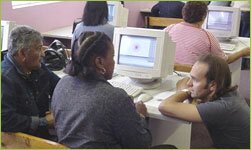
tuXlab EXPANSION Internally initiated in 2002 to establish open source based computer labs in the Western Cape as an ICT model for schools, the tuXlab project is now expanding to other provinces. One of the project goals is to use minimal internal resources but make use of volunteers as resources for the establishment of the labs. The main aim of the project is two-fold: firstly, it is to prove that open source software can be the preferred technology for the establishment of computer labs in schools. Secondly, it is to create and increase the awareness, use, skills and availability of open source software. During 2003/04 the Foundation established 90 tuXlabs in Western Cape schools with an approximate investment of R 2.1 million. Based on the success of this programme, its credentials as an ICT model, increased computer donations, co-funding, sponsorships and collaboration partnership opportunities, it was decided to extend the tuXlab to incorporate Limpopo, Eastern Cape as well as the continuation of the Western Cape activities.
At the recent tuXlab Roadshow (February 2005) attended by Mark Shuttleworth and Mr Enver Surty (Deputy Minister of Education) held in Cape Town, the Shuttleworth Foundation announced its plans to extend the activities of the tuXlab programme into a further 100 schools. The additional 100 tuXlabs would be divided as follows:
On completion of the course the educators went back into their classrooms and are currently working on the implementation of the programme. The group will get together once every term to discuss problems and share approaches to classroom implementation. The EMDC has appointed three curriculum advisors to monitor and evaluate the programme. We would like to commend these educators for their dedication and commitment to the programme. They have offered up their Saturday mornings for almost four months to participate in this project. We would also like to extend a special thank you to Ms Robyn Davies, an educator at Western Province Preparatory, for volunteering to train the selected educators.
GET WITH THE SCIENCE The HIP2B2 TV show has made history by becoming the first youth magazine show to be broadcast live from Cape Town. Since August last year, teenagers' minds have been stretched, challenged, expanded, excited and enlightened every Monday afternoon at 16h30 on SABC2. The programme is set to run for the next three years, and the producers are promising to keep the Science programme innovative and thrilling. The show is sponsored by Eskom and aims to foster an interest in Science, Technology, Entrepreneurship and Maths in today's teenagers, who are generally accused of being more interested in things like fashion and music than in aerodynamics, radiation and static electricity. But with the fun, gorgeous and funky presenters and interactive and fun presentation of subject matter, the Hip2B2 TV show is set to steal attention from the most apathetic of teenagers, and get them thinking about the world in which they live and how it operates. The objective of the series is to foster an interest in science by highlighting real work, every day applications of classroom-taught Science. Science becomes so much more interesting and exciting when viewers get taken straight to location to find out more about tornadoes, satellites, cell phones, diamond mining, the mechanics of skateboarding and more, every single week.
Show sponsor, Eskom, provides an insert, presented by scholars who have taken part in the Eskom Expo for Young Scientists. This insert showcases Expo projects like the solar-powered fridge and the landmine detector, invented by budding scientists. Issues relating to power and electricity such as power generation and energy conservation are also discussed in this insert. Spunky presenters Marcel Pretorius, Charles Tertiens and Precious Kofi ensure that things are kept up-beat and energetic throughout the 26-minute programme, leaving no time at all for boredom! Check out www.hip2b2.com/air/ for details of upcoming shows (and past shows) and to find out more about the lives of the presenters. If you're interested in ordering VHS/DVD copies for your school on any of the episodes, please send an email to Or fax us on (021) 970 1217.
Is there a best-practice model for organising expo activity in schools and providing support to both educators and learners? The Shuttleworth Foundation hosted an expo discussion forum on the 14th of March 2005, which was attended by educators, individuals and organisations involved in organising expo projects in schools in the Western Cape (Medical Research Council & IMSTUS) and Kwa-Zulu Natal (PIMSTA). The main aim of the forum was to answer the question: Is there a best way of organizing expo projects in schools in order to ensure adequate support andinvolvement by both learners and educators? In attempting to answer this question the group acknowledged that there cannot be a “one size fits all” approach to organizing expos in schools, but rather the focus should be on the sharing of experiences in terms of what seems to work well, what does not seem to work and how these challenges have been dealt with. The following were shared as “ingredients” that have been tried and proven to work in the different areas:
www.GreaterGoodSA.co.za, in partnership with the Shuttleworth Foundation, is launching a new service on their web-based interchange that provides an innovative channel dedicated to the improvement of education in South Africa. We are calling educators throughout South Africa to participate in Teacher's Dream, by putting forward proposals for grants from R100-00 up to R5000-00 to fund specific activities, outings or events that will enhance your lessons for the benefit of learners. To be part of this exciting launch, your proposals must reach us by 31st May. After that, proposals will be accepted all year round. We know that teachers have brilliant ideas of how to make Maths and Science come alive; how best to demonstrate Life Skills; how to show children the Geography of the land and how to explore the metaphors of the Arts. Many of these big ideas could easily come to fruition with the support of small grants. In real terms, it actually doesn't cost that much to take your Grade 4 learners to the planetarium or the Grade 10's to an inspiring exhibition. There are many activities outside the classroom that would build children's capacity through experiential learning, and enhance the learning outcomes of the Revised National Curriculum Statement (RNCS). Teachers Dream works very simply: educators from around the country can register online at www.GreaterGoodSA.co.za. Your status as an active teacher will be verified with your school principal and the SA Council of Educators. Proposals can then be submitted to www.GreaterGoodSA.co.za for approval by post, fax or email. Approved proposals are posted on the website, and a barometer is set up to mark the progress of the fund-raising effort. Once the full donation has been received www.GreaterGoodSA.co.za provides you with the means for you to fulfil your dream. A condition of the donation is that you provide your donors with a report back via www.GreaterGoodSA.co.za. You will receive a disposable camera to record your dream which you must post back to us, along with written feedback from yourself and your learners. Through Teachers Dream you can connect to the generosity of the public and private sectors. Your approved project proposals will be featured on the site providing opportunities for individuals, organisations and businesses, who would like to contribute to the improvement of education to support specific, meaningful projects at a school level.
Remember that, if you have an interesting and innovative pilot project which aims to assist in the development of Science, Technology, Entrepreneurship and Maths, in education in South Africa, please send your proposal to: , or fax (021) 970 1201. Visit www.shuttleworthfoundation.org for more information or contact (021) 970 1200. If you are a corporate or business that wants to get involved in the funding of projects and programmes on a national scale, you are also invited to give us a call.
 P.O.Box 4163, Durbanville 7551, South Africa Tel + 27 21 970 1200 • Fax + 27 21 970 1201 www.shuttleworthfoundation.org • Please contact to be added to or removed from this mailing list, or visit our website. This newsletter is constructed and managed with Ubuntu Media's E-Bean publishing system |